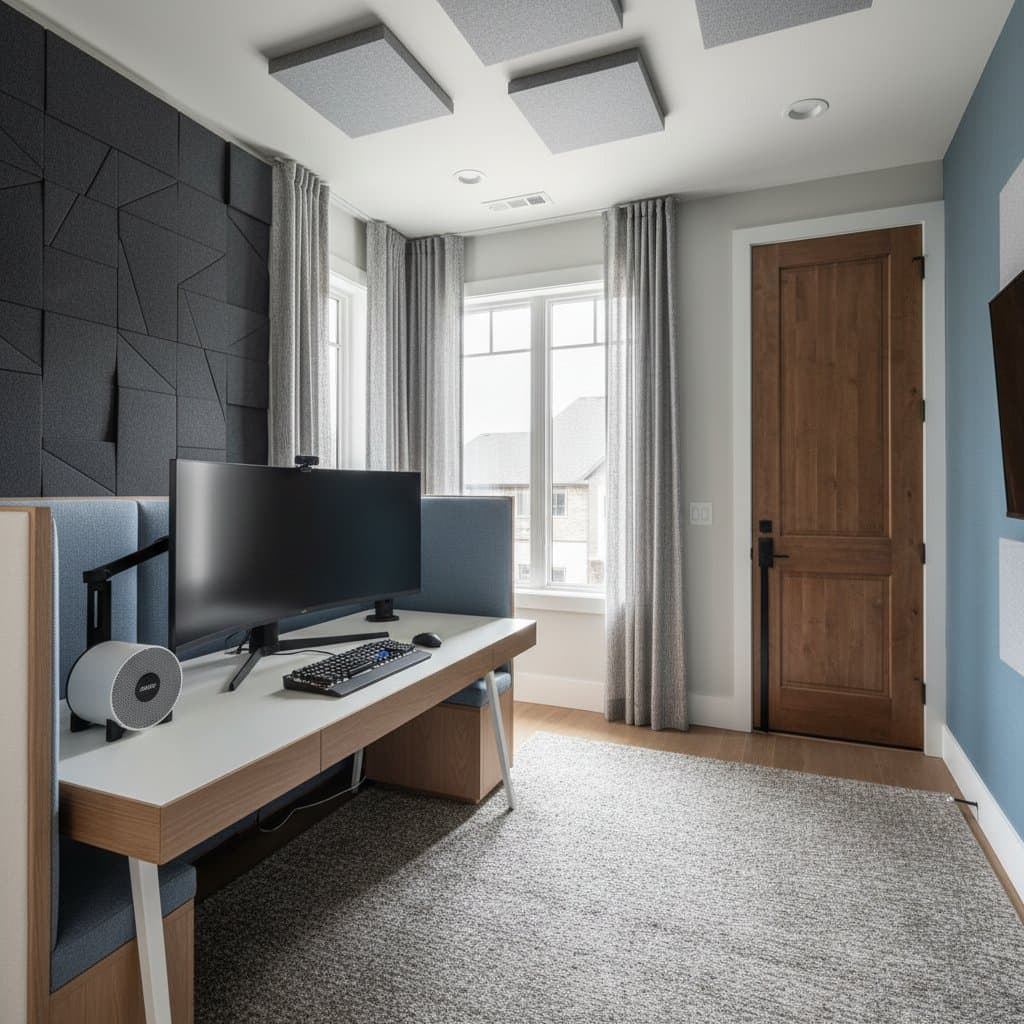
Understanding the True Costs of Soundproofing a Home Office in 2026
Professionals increasingly rely on home offices for video calls, audio editing, and focused work. External noise disrupts these activities and hampers productivity. Effective soundproofing goes beyond basic foam panels; it demands attention to materials, structural modifications, and precise installation.
This guide details expected expenses for soundproofing a home office in 2026. It covers materials, labor, and proven techniques to achieve substantial noise reduction.
Overall Cost Breakdown
Soundproofing a home office typically ranges from $1,200 to $8,000. Factors include room dimensions, chosen materials, and project scope. For a compact 100-square-foot space, basic DIY approaches fall between $1,200 and $2,500. Comprehensive professional treatments for larger areas exceed $6,000.
Labor accounts for 40 to 60 percent of expenses in professional projects. Individuals skilled in basic carpentry and sealing can cut costs through selective DIY efforts.
Addressing Ceilings and Floors
Footsteps from above or vibrations from below transmit noise through ceilings and floors. Effective solutions combine insulation with decoupling to isolate sound paths.
Ceiling Modifications
Insert fiberglass or mineral wool insulation into joist spaces at $1.25 to $2.00 per square foot. Pair this with resilient channels and fresh drywall layers for $4.00 to $6.00 per square foot. These steps minimize transmission from overhead activities.
Floor Solutions
Install carpeting over dense underlayment to dampen both airborne sounds and impacts, costing $3.00 to $5.00 per square foot. On hardwood or laminate surfaces, place acoustic mats or rubber underlayments at $2.00 to $4.00 per square foot. Advanced floating floors, which decouple the finish from the subfloor, deliver superior isolation up to $7.00 per square foot when installed.
Incorporating Acoustic Panels and Furnishings
Airborne noise dominates in many home offices, where echoes distort calls and recordings. Acoustic panels and soft elements absorb these sounds, enhancing room clarity.
Available Panel Types
- Fabric-wrapped fiberglass panels range from $80 to $150 per unit.
- Foam tiles or self-adhesive options cost $2.00 to $5.00 per square foot.
- Decorative art panels, blending function with aesthetics, price at $150 to $300 each.
Cover approximately 30 percent of wall surfaces to optimize absorption without dulling the space. Such configurations total $600 to $1,200.
Weighing DIY Against Professional Services
Surface enhancements like gap sealing, door sweeps, and panel mounting suit DIY projects. Structural alterations, including drywall additions or ceiling decoupling, require expert intervention.
DIY Approach
Focus on materials alone for $1,200 to $2,000 in a small room. Allocate 15 to 25 hours over weekends. This method empowers homeowners to target specific issues affordably.
Professional Route
Expect $3,500 to $8,000 for full retrofits encompassing walls, windows, and doors. Projects complete in three to five days. Homeowners blending professional structural work with personal finishing often save 25 percent, as noted in online improvement forums.
Essential Safety and Compliance Measures
Wall and ceiling adjustments may reveal wiring or existing insulation. Disconnect power to the area prior to any cutting or drilling. Select fire-rated sealants and code-compliant materials.
In shared buildings, consult property management regarding modifications to walls or ventilation systems. These precautions ensure safety and avoid disputes.
Implementing Effective Soundproofing
Investing in a soundproofed home office boosts concentration and output. Begin with low-cost seals on doors or basic panels under $1,000 to curb immediate distractions.
For studio-level quiet, pursue full systems with isolated structures, layered drywall, and upgraded windows, though these demand thousands. Assess noise entry points first, then select targeted solutions. This strategy yields a serene environment for sustained focus and clear professional interactions.