- Clearance needs: 6 inches surrounding the tank for maintenance access
- Gas models: Flue or wall venting systems
- Electric models: Dedicated 240-volt circuit
Tankless Installation
Transitioning to a tankless system often requires substantial modifications. Gas line upgrades to 3/4-inch diameter and potential vent resizing become necessary when replacing a tank unit. Electric variants may necessitate a 200-amp electrical panel.
Breakdown of installation costs includes:
- Labor: $1,000 to $2,000
- Upgrades for venting or electrical: $500 to $1,500
- Permits and inspections: $100 to $300
The compact design of tankless heaters allows repurposing of freed-up space in closets or on floors.
Long-Term Costs: Energy and Maintenance
Energy Efficiency
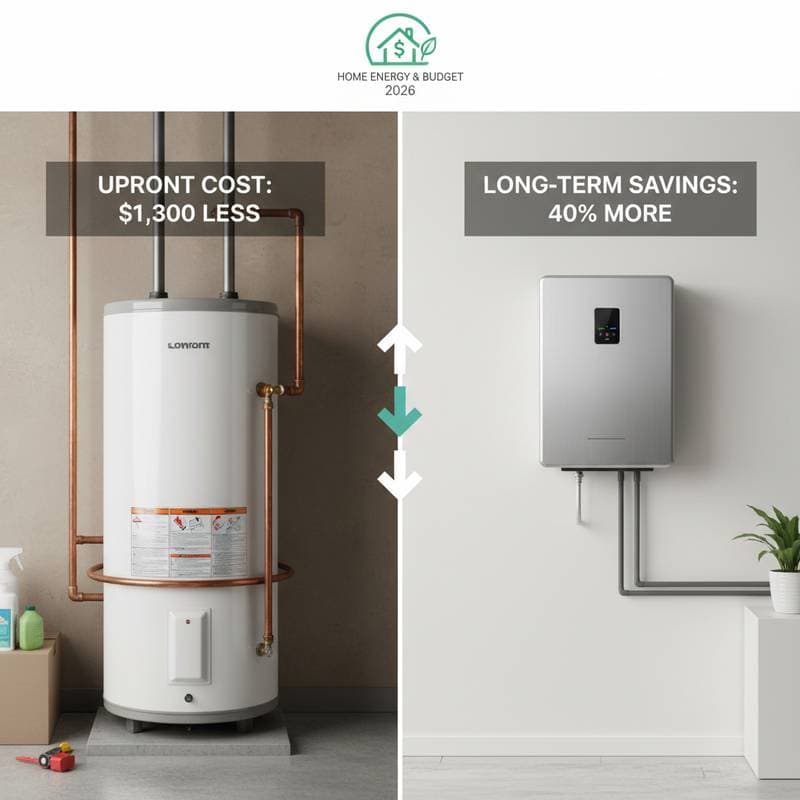
Conventional gas water heaters operate at roughly 60 percent efficiency, with 40 percent of energy lost as waste heat. Tankless models attain up to 95 percent efficiency, yielding annual savings of $100 to $200 for average households.
Savings amplify in scenarios of intensive usage. Families with multiple members or several bathrooms realize the greatest returns, whereas smaller households experience slower cost recovery on the elevated initial outlay.
Maintenance and Repairs
Regular upkeep sustains performance in both systems:
- Traditional: Annual tank flushing removes sediment buildup; anode rod replacement occurs every 3 to 5 years.
- Tankless: Yearly descaling of the heat exchanger using vinegar counters mineral accumulation; inlet filters require cleaning.
Repair expenses vary. Traditional tank replacements cost $600 to $1,000, while tankless component fixes, such as sensors or valves, range from $200 to $600.
Comparing Key Factors
| Feature | Traditional Tank | Tankless |
|---|---|---|
| Average installed cost | $1,200 - $2,500 | $2,500 - $4,500 |
| Lifespan | 8 - 12 years | 15 - 20 years |
| Energy efficiency | 60% - 67% | 80% - 95% |
| Hot water supply | Limited by tank size | Continuous |
| Space requirement | Large floor space | Wall-mounted |
| Maintenance | Flush tank annually | Descale annually |
| Ideal household size | 1-4 people | 3+ people or high usage |
Accessibility and Safety Considerations
Tankless heaters accommodate accessibility requirements through adjustable mounting heights of 18 to 60 inches from the floor, facilitating control access. Consistent water temperatures minimize scalding risks. Traditional tanks can incorporate mixing valves to achieve similar temperature stability.
Gas models in either category adhere to ventilation and carbon monoxide protocols. Compliance with the National Fuel Gas Code and National Electric Code remains essential prior to installation.
DIY Feasibility and When to Hire a Pro
Experienced individuals with plumbing knowledge may undertake DIY installation of a traditional electric water heater, provided familiarity with local regulations exists. Required tools and materials include:
- Adjustable wrench and pipe cutter
- Dielectric unions for dissimilar metal connections
- Drain pan and pressure relief valve
- Teflon tape and pipe sealant
Tankless installations prove unsuitable for DIY efforts due to complexities in gas sizing, venting, and electrical enhancements that demand professional inspection. Engage a licensed plumber or certified tankless specialist for such projects.
Common Mistakes to Avoid
- Undersizing the tankless unit. Compute the aggregate flow rate; residences with concurrent operation of two showers and a dishwasher require 7 to 9 gallons per minute capacity.
- Overlooking water hardness levels. Water exceeding 7 grains per gallon accelerates wear; integrate a softening system as needed.
- Improper venting selection. Gas tankless units mandate stainless steel or PVC materials rated for elevated temperatures.
- Bypassing permit processes. Local authorities generally mandate inspections before activating gas or electrical connections.
- Excessive temperature settings. Maintain 120 degrees Fahrenheit to avert scalds and conserve energy.
Making It Happen
Evaluate your home's gas or electrical infrastructure and assess available wall space initially. Obtain a minimum of two detailed quotes encompassing upgrades and permit costs. Following installation, adhere to scheduled maintenance to safeguard the system's longevity and efficiency.