Water Heater Replacement Cost: Tank vs Tankless Prices
Replacing a water heater involves more than comparing purchase prices. Installation conditions, fuel type, household demand, venting requirements, permits, and future energy use all affect the final bill. For many homeowners, a standard tank water heater costs less to install. A tankless model often costs more at the start, yet it can reduce standby heat loss and provide continuous hot water.
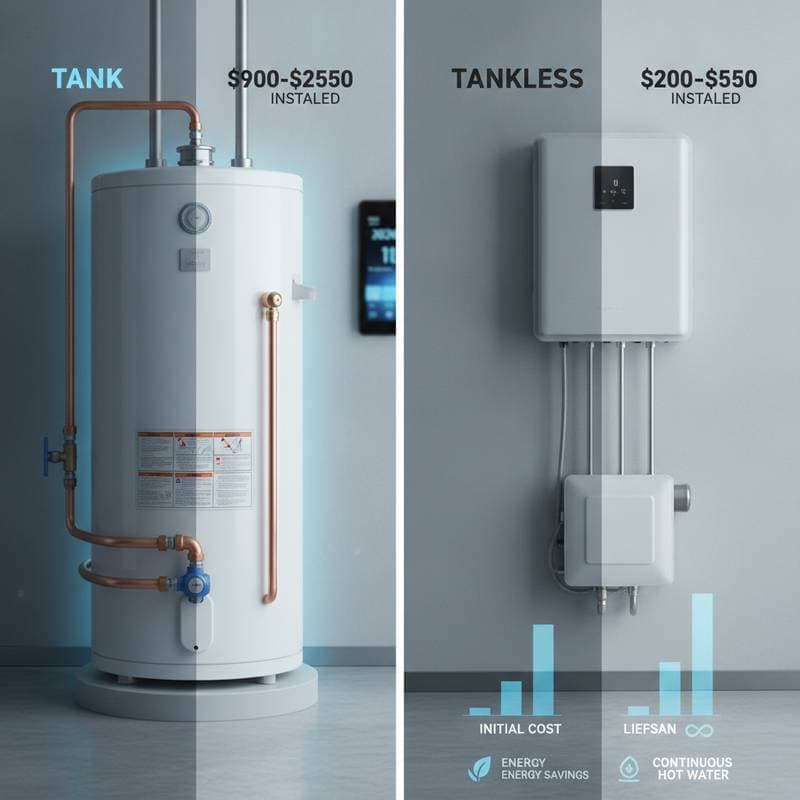
A practical replacement budget for a tank unit is usually $900 to $2,500, including installation. Tankless replacement commonly ranges from $2,000 to $5,500. Electric models tend to cost less than gas models, while difficult access, upgraded wiring, new gas lines, or vent changes can raise either estimate.
Average Water Heater Replacement Prices
The following ranges cover common residential installations. Local labor rates and equipment quality can move the final price outside these figures.
| Water heater type | Equipment cost | Typical installed cost |
|---|---|---|
| Electric tank | $400 to $1,200 | $900 to $2,000 |
| Gas tank | $600 to $1,800 | $1,200 to $2,500 |
| Electric tankless | $700 to $2,500 | $1,800 to $4,000 |
| Gas tankless | $1,200 to $3,500 | $2,500 to $5,500 |
A basic tank replacement usually uses existing connections, drain piping, shutoff valves, and venting. A tankless installation may require larger electrical circuits, upgraded gas piping, new vent materials, condensate drainage, or several hours of additional labor.
Homeowners should request an itemized quote. Ask the contractor to separate equipment, labor, permits, disposal, code upgrades, expansion tank installation, water shutoff replacement, and warranty coverage.
Tank Water Heater Costs
Tank water heaters store a supply of heated water in an insulated cylinder. Common residential sizes range from 30 to 80 gallons. A two-person household often uses a 40 or 50 gallon unit, while larger households may need 50 to 80 gallons depending on bathing habits, laundry use, and simultaneous demand.
Tank systems offer three main advantages. Lower purchase and installation costs make them accessible for most budgets. Simple operation and widely available replacement parts reduce long-term service concerns. Easier servicing for most licensed plumbers means faster response times when repairs become necessary.
Their main limitation is finite capacity. Once the stored water is used, the household must wait for the burner or heating elements to recover. A poorly insulated or aging tank can also lose heat while sitting unused.
Tank life commonly falls between 8 and 12 years, though water quality, maintenance, and installation quality affect service life. Annual inspection can identify leaking valves, rust, damaged wiring, or pressure problems before they cause property damage.
Gas tanks may heat water faster than many electric tanks, but they need safe combustion air and proper venting. Electric tanks usually have simpler installation requirements, although a replacement may need updated wiring or a larger circuit.
Tankless Water Heater Costs
Tankless systems heat water as it passes through the unit. They do not store a large reserve, so they avoid much of the standby loss associated with storage tanks. A properly sized unit can supply hot water for long periods, but its output depends on incoming water temperature and flow rate.
Tankless systems often cost more for several reasons. The unit itself carries a higher price. Gas models may need larger supply lines. Venting may require specialized materials. Electric models may need one or more high capacity circuits. Installation can involve wall mounting, condensate drainage, and new isolation valves.
Tankless equipment often lasts 15 to 25 years when maintained correctly. Gas units usually require periodic flushing to remove mineral buildup from the heat exchanger. Hard water can shorten service life and reduce heating performance, so a filter or water treatment system may be useful.
The system must match the household's peak demand. A unit that supplies 8 gallons per minute may support several fixtures, but actual performance drops when groundwater is cold. A professional should calculate flow rate and temperature rise rather than select a model by household size alone.
Energy Costs and Long Term Value
A tankless water heater can reduce energy waste because it does not keep a full tank hot around the clock. Savings depend on fuel prices, household water use, incoming water temperature, insulation, and the efficiency of the selected model. A household with modest demand may see smaller savings than a large family that uses hot water throughout the day.
Tank systems remain a sensible choice when installation funds are limited or when the existing setup is simple. A high efficiency tank with good insulation may deliver dependable service without the electrical or gas upgrades required by tankless equipment.
The lowest purchase price is not always the lowest ownership cost. Compare the equipment price, installation work, expected service life, maintenance, energy use, and warranty. Ask the contractor to estimate annual operating expenses using your current fuel or electricity rates.
Hidden Costs That Affect the Quote
Several conditions can change a water heater replacement cost after the old unit is removed. Permit fees may apply when local authorities require permits and inspections. Code upgrades in older homes may need seismic straps, a drain pan, a temperature and pressure discharge pipe, or an expansion tank.
Access problems arise when units sit in attics, tight closets, or finished basements. These locations take longer to remove and replace. Water damage from a leaking tank may have damaged flooring, drywall, framing, or nearby insulation.
Fuel changes create additional expenses. Switching from gas to electric may require a new circuit and panel capacity. Venting changes for a tankless gas system may need new intake and exhaust routing. Some contractors charge separately to haul away the old equipment.
Choosing the Right System
Choose a tank water heater when the priority is lower upfront cost, straightforward replacement, and easy local service. This option often suits rental properties, smaller renovation budgets, and homes with existing tank connections in good condition.
Choose tankless when continuous hot water, compact size, and long service life matter. Tankless can work well for households with high demand, limited storage space, or plans to remain in the home long enough to recover the higher installation cost.
Ask these questions before approving the work. What is the calculated peak flow rate? Does the home need electrical, gas, venting, or drainage upgrades? What maintenance does the manufacturer require? What parts and labor does the warranty cover? Is the quote fixed, and which items could increase the price?
Planning a Reliable Replacement
Replace a water heater before a minor leak becomes a major repair. Rust around the base, inconsistent temperatures, popping sounds, cloudy water, or repeated relief valve discharge indicate that a professional inspection is needed.
Get at least two detailed estimates from licensed contractors. Compare the full installed price instead of the equipment label alone. A properly sized unit, correct installation, accessible shutoff valves, and routine maintenance will protect the investment.