Water Softener Installation Costs and Return on Investment
Hard water causes gradual damage inside homes through mineral deposits. These deposits reduce appliance efficiency and create buildup in pipes and fixtures. A water softener removes calcium and magnesium ions at the point of entry. Calculating total costs alongside expected savings supports sound decisions for any household.
Typical Installation Costs
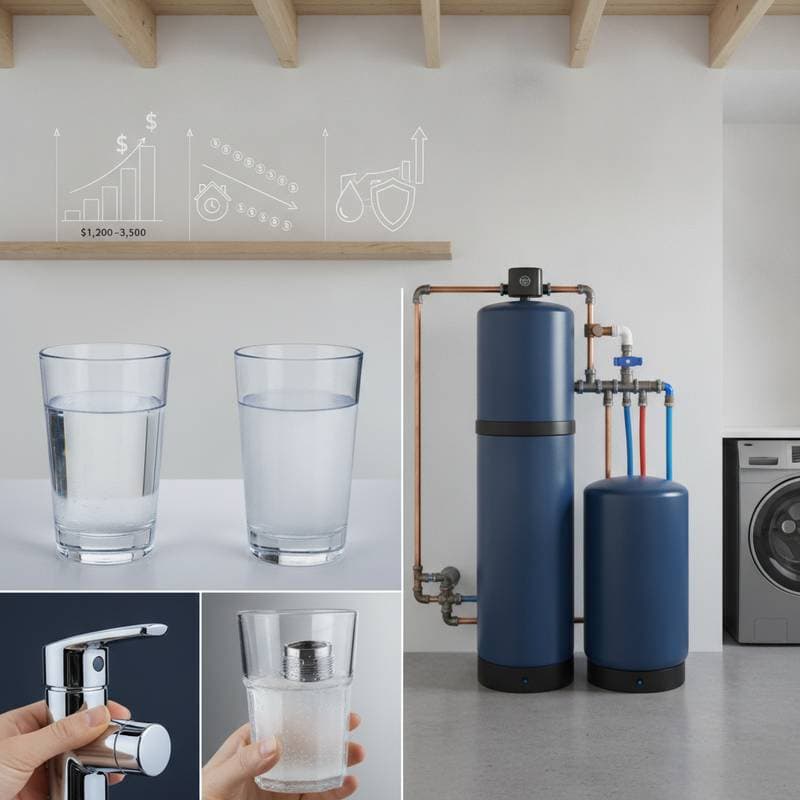
A standard water softener system ranges from $1,200 to $3,500 when both equipment and labor are included. Smaller units for one or two occupants begin near $800. Larger whole-house models with added filtration reach $5,000.
Costs break down across several components.
- Water softener unit: $600 to $2,500, depending on grain capacity and valve type.
- Labor for connections and testing: $400 to $1,000.
- Extra plumbing modifications: $100 to $500.
- Replacement salt or resin: $30 to $80 per bag for routine upkeep.
Final pricing reflects measured water hardness, number of bathrooms, and existing pipe access.
Return on Investment Timeline
Most households recover the initial outlay within three to six years. Savings accumulate through lower utility use and fewer repairs.
Scale inside a water heater can raise energy consumption by as much as 30 percent. Softened water prevents this loss. Pipes and fixtures also experience less corrosion, which extends service life. Dishwashers and washing machines require fewer service calls. Households no longer purchase repeated quantities of descaling chemicals.
A family of four that uses 250 gallons daily typically saves $400 to $600 annually across energy, detergent, and maintenance categories.
Selecting a System Type
System choice depends on hardness level and daily demand.
Salt-Based Ion Exchange Units
These systems suit homes above 10 grains per gallon. Installed prices fall between $1,200 and $3,000. Calcium and magnesium ions exchange for sodium during regeneration cycles. Regular salt additions maintain performance.
Salt-Free Conditioners
Mild hardness situations benefit from these units. Installed prices range from $1,000 to $2,500. Minerals remain in solution but lose the ability to form scale. No sodium enters the water and maintenance stays minimal.
Dual-Tank Configurations
Large households or properties with round-the-clock demand select dual-tank models. Installed prices start at $2,500 and reach $5,000. Alternating tanks guarantee continuous soft water during regeneration.
Magnetic or Electronic Descalers
Renters or compact spaces often choose these clamp-on devices. Installed prices lie between $200 and $800. Electromagnetic fields alter mineral behavior inside pipes. Effectiveness drops in very hard water conditions.
Installation Options
Homeowners comfortable with basic plumbing can complete a pre-plumbed unit in three to five hours. Required tools include a pipe cutter, adjustable wrench, and thread sealant. Accessible main supply lines simplify the process.
Professional installation becomes necessary when rerouting pipes, adding a drain line, or tying into an existing filter array. Licensed technicians verify bypass valves, pipe diameters, and local code compliance. Warranties remain valid only after certified work.
Avoiding Common Errors
- Match capacity to actual hardness and usage; a family of four generally needs 32,000 to 40,000 grains.
- Confirm inlet pressure meets or exceeds 30 psi for reliable regeneration.
- Maintain salt levels and schedule resin cleaning at recommended intervals.
- Install the discharge line with an air gap to block backflow.
- Test source water hardness before equipment selection.
Ongoing Maintenance Requirements
Annual inspections of valves and brine tanks keep systems efficient. Resin cleaning every two to three years prevents channeling. Homeowners record monthly salt usage and water meter readings to track performance against projected savings.
Planning Professional Installation
Test water hardness first, then size equipment to household demand. Obtain multiple quotes that itemize parts and labor. Schedule work during periods of low water use to minimize disruption. Proper selection and installation protect plumbing and deliver measurable savings for years afterward.