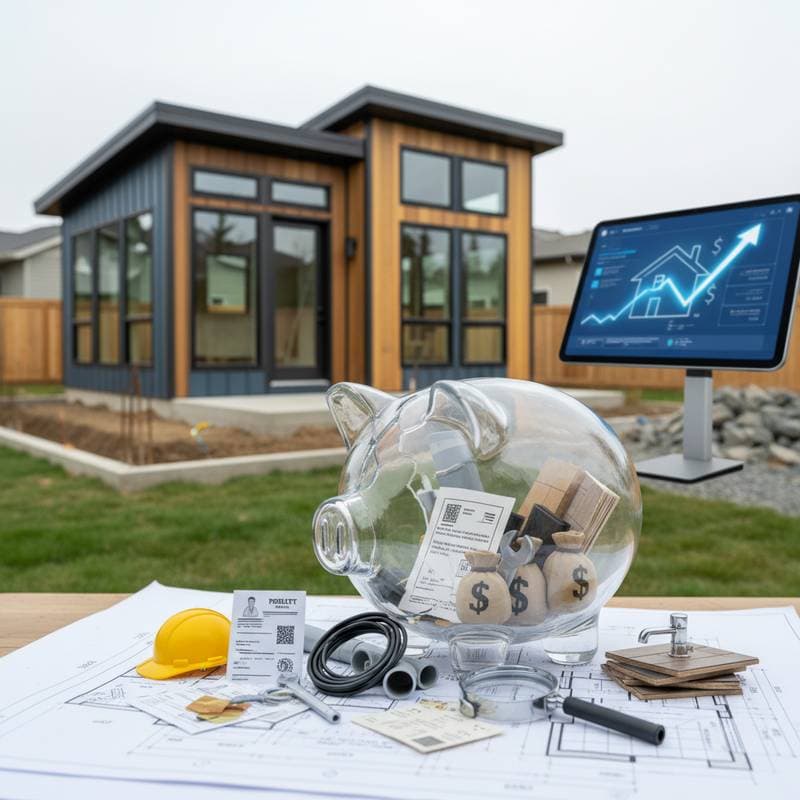
What It Really Costs to Build a Granny Flat in 2025
A granny flat, also known as an accessory dwelling unit or ADU, serves as a practical expansion for homeowners seeking more living space or income potential. Families use these units for multigenerational housing, while others convert them into rentals or home offices. Total costs hinge on design selections, site specifics, and regulatory demands, so early awareness of expense drivers enables informed choices.
Understanding the Basic Cost Range
Granny flats span simple studios to complete two-bedroom setups. In most areas, expect totals from $75,000 to $150,000, covering design, permits, site work, construction, and finishes. Modular or prefabricated options keep figures lower, whereas bespoke designs or luxury elements elevate them.
Builders on platforms like Houzz report that minor upgrades, such as enhanced insulation or custom windows, accumulate rapidly. One homeowner described a 500-square-foot ADU where initial quotes seemed manageable, yet utility trenching inflated the bill by $5,000. Such examples highlight the value of upfront cost forecasting to avert overruns.
Key Cost Categories to Plan For
Dividing expenses into categories reveals allocation priorities. Each area impacts the project's quality and longevity.
-
Design and Permitting
Architectural drawings, engineering reviews, and permit applications typically cost $2,000 to $5,000. Certain locales mandate seismic or energy evaluations, increasing fees. Selecting pre-approved plans from builders cuts expenses and accelerates approval, though it limits personalization. -
Site Preparation
Vegetation removal, grading, and foundation work vary with terrain challenges. Sloped lots demand extra excavation, potentially adding $10,000 or more. Utility extensions for water, sewer, and power prove costly if distances exceed 50 feet from the main house. -
Construction Costs
Framing, roofing, insulation, and exterior work claim the bulk of funds, often 50 to 60 percent of the total. Vinyl siding and laminate floors maintain affordability, but options like brick veneer or tile escalate prices. Labor rates rise in competitive markets, where contractors charge $50 to $100 per hour. -
Utilities and Systems
Wiring, plumbing, and heating, ventilation, and air conditioning installations account for 15 to 20 percent of budgets. Linking to the primary residence minimizes outlays but might necessitate panel upgrades costing $1,500. Standalone setups provide independence at a premium of $8,000 to $12,000. -
Interior Finishes and Fixtures
Elements like cabinetry, surfaces, and illumination personalize the space. Opt for stock cabinets and quartz counters to balance cost and style. Homeowners who tackle painting and trim installation save $2,000 to $4,000 while upholding standards.
Comparing Construction Options
The market features three primary methods, each balancing cost, speed, and adaptability.
Prefab or Modular Units:
Factory assembly minimizes on-site errors and waste. Delivery and setup occur in weeks, slashing labor by 20 percent. Drawbacks include restricted modifications for irregular lots.
Custom Stick-Built Units:
Full customization aligns with the main home's style and site contours. These projects demand 3 to 6 months but ensure seamless integration. Costs rise 30 percent over modular due to tailored elements.
Garage Conversions or Basement ADUs:
Repurposing existing areas leverages pre-built foundations, reducing totals by 40 percent. Challenges involve retrofitting for light and access, potentially requiring $15,000 in structural tweaks.
Regional Factors That Influence Cost
Geography shapes expenses through regulations and resources. Cities impose rigorous zoning and charge $1,000 more in fees, while rural sites need septic systems at $10,000 to $20,000. Seismic zones add engineering reports, boosting costs 10 to 15 percent.
Zoning limits size to 800 square feet in many places and mandates parking spots. Early consultation with local experts avoids redesign fees of $3,000 or delays spanning months.
DIY Savings Versus Professional Builds
Self-building appeals for its potential 25 percent labor reduction, equating to $20,000 on a mid-range project. Success requires code familiarity and tools investment. Errors in electrical or framing demand professional corrections, erasing gains.
Professionals guarantee adherence and warranties, justifying higher fees. A hybrid model works well: contract for foundations and hire for inspections, then finish interiors personally. This approach trims 15 percent while preserving integrity.
Budgeting for Hidden and Ongoing Costs
Beyond core builds, anticipate these often-ignored items:
- Permitting and Inspection Revisions: Inspector feedback might require $2,000 in adjustments.
- Utility Upgrades: Expanding service capacity adds $3,000 to $7,000.
- Landscaping and Access: Paths and fencing enhance usability at $5,000.
- Insurance and Taxes: Added value increases premiums by 10 percent annually.
- Maintenance: Allocate $1,000 yearly for repairs and upkeep.
Cost-Effective Design Strategies
Targeted choices optimize funds without comfort loss.
- Compact Layouts: A 400-square-foot efficient design outperforms a sprawling inefficient one.
- Shared Utilities: Proximity to main lines cuts connection costs by half.
- Energy Features: Superior insulation recoups $500 yearly in savings.
- Simple Roofing: Gable designs avoid $4,000 in complex framing.
- Standard Materials: Off-the-shelf items reduce custom fabrication by 20 percent.
Protecting Your Granny Flat's Value Over Time
Regular care sustains the unit's appeal and functionality. Conduct roof and system checks biannually to catch issues early. Preserve exteriors against weather to extend lifespan.
Monitor utility trends to refine efficiency. For rental use, dedicated upkeep plans offset costs through steady income. This investment secures lasting property enhancement and financial advantages.