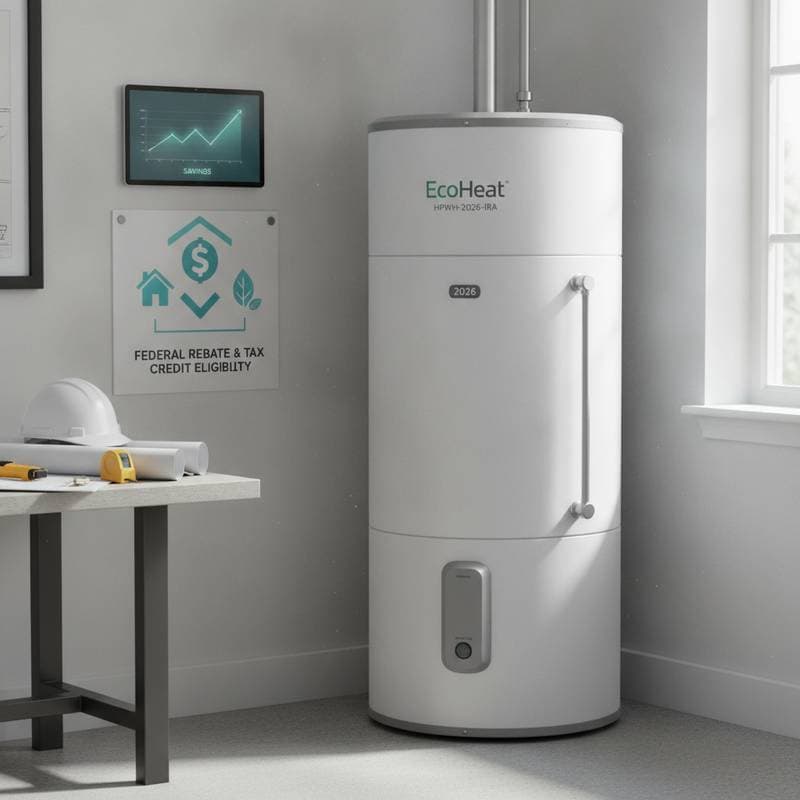
Do Not Miss 2026 Federal Rebates on Heat Pump Water Heaters
Homeowners face rising energy costs each year. New federal incentives can make heat pump water heaters an affordable upgrade. These systems reduce utility bills while improving household efficiency.
Heat pump water heaters move warmth from surrounding air into stored water. This approach uses far less electricity than traditional models. The 2026 rebates will lower purchase prices and speed adoption across income levels.
How These Units Operate
The appliance extracts heat from indoor air and delivers it to the tank. It achieves up to three times the efficiency of standard electric resistance heaters. Most units offer heat pump, hybrid, and electric modes to match daily demand.
Units need roughly 700 cubic feet of ventilated space such as a basement or garage. They release cooler air that can reduce humidity in the room. Installation follows standard plumbing connections yet may require added electrical circuits or ducting.
Savings Available Through 2026 Rebates
The rebates deliver point of sale discounts on qualifying models. Moderate income households can receive substantial coverage while lower income households may qualify for nearly complete reimbursement. ENERGY STAR certified units meet the expected performance thresholds.
A typical 50 gallon model costs between 1200 and 2500 dollars before incentives. Installation adds 500 to 1500 dollars depending on site conditions. Combined federal support can reduce net expense by 600 to 1750 dollars or more when state programs apply.
Stack Incentives for Maximum Reduction
Homeowners can combine the rebate with the existing 30 percent federal tax credit. Consider a 1800 dollar unit plus 1000 dollars in labor. The tax credit returns 840 dollars while a 1000 dollar rebate lowers the final outlay to roughly 960 dollars.
Keep all receipts and model documentation. Confirm income eligibility and contractor requirements on official program sites before purchase.
Long Term Energy and Comfort Gains
These heaters cut water heating energy use by about half. A family of four can save 150 to 400 dollars annually on electricity. Over a decade the cumulative savings often exceed several thousand dollars.
Newer models include quiet compressors rated near 50 decibels and optional Wi Fi controls. Some units participate in utility demand response programs that provide bill credits for off peak operation.
Site Preparation Steps
Verify that the electrical panel supports a dedicated 240 volt circuit. Older panels may need an upgrade costing several hundred dollars. Place the unit where indoor air remains above 40 degrees Fahrenheit and route condensate to an approved drain.
Switching from gas requires a licensed professional to cap the gas line safely. Local utilities sometimes add extra incentives for fuel switching projects.
Select and Schedule the Upgrade
Review ENERGY STAR rated models from established manufacturers. Obtain multiple quotes from contractors experienced with heat pump installations. Time the project to align with rebate availability while the current heater still functions.
Address Typical Questions
Recovery rates on current models support households of four or more when the proper tank size is chosen. Noise remains low when the unit sits in a basement or garage. Cold climate performance has improved and optional duct kits can draw warmer air if needed.
Broader Household Advantages
Lower electricity demand reduces carbon emissions at the household level. Expanded production and installation work also supports local contractors and manufacturers.
Next Actions for Homeowners
Assess the age of the existing water heater. Request site evaluations from qualified installers. Compare warranties, efficiency ratings, and smart features before final selection.