Essential Tips for Choosing Home Battery Backups in 2026
A sudden power outage always seems to happen when least expected. Homeowners may be cooking dinner or working from home when everything goes dark. Installing a home battery backup system protects the household from outages while improving energy independence. With many options available, selecting the right system requires clear information on capacity, output, and compatibility.
Why Home Battery Backups Matter
A home battery backup stores electricity for use when the grid fails or energy costs rise. It provides assurance that essential systems such as refrigerators and routers continue operating. Many homeowners pair battery backups with solar panels to store excess energy and reduce grid reliance.
Understanding power requirements, desired duration, and property suitability allows selection of a unit that delivers reliable performance without excess cost.
Quick Overview
- Battery capacity: Most homes require 10 to 20 kilowatt hours for basic backup. Larger homes or high demand appliances may need up to 40 kilowatt hours.
- Power output: Select continuous output between 5 and 10 kilowatts to manage essential circuits.
- Installation cost: Budget 8000 to 18000 dollars for a complete system including installation.
- Lifespan: Quality lithium ion batteries last 10 to 15 years depending on usage and conditions.
- Integration: Systems compatible with solar panels or smart controls provide greater long term value.
The following sections explain how to calculate power needs, compare battery types, and complete installation correctly.
Understanding Capacity and Power Ratings
Capacity: How Much Energy You Can Store
Battery capacity measured in kilowatt hours determines backup duration. A 10 kilowatt hour battery can operate a refrigerator that uses roughly 1.5 kilowatt hours per day along with several lights for more than one day. Heavier loads such as heating ventilation and air conditioning systems require 20 kilowatt hours or greater.
Calculate needs by listing appliances, checking wattage labels, multiplying wattage by expected runtime hours, and dividing the total by 1000. Most homeowners find that 15 kilowatt hours covers essentials for one day while 25 to 30 kilowatt hours supports near normal operation during extended outages.
Power Output: How Much You Can Use at Once
Power output measured in kilowatts indicates simultaneous load capacity. A 5 kilowatt system supports lighting, electronics, and refrigeration. Well pumps, electric ovens, or central air conditioning require 8 to 10 kilowatts or higher.
Startup surges for appliances such as sump pumps can briefly double power draw. An installer can size the inverter to accommodate these peaks.
Comparing Battery Technologies
| Battery Type | Typical Capacity Range | Lifespan | Maintenance | Best For |
|---|---|---|---|---|
| Lithium ion | 10 to 40 kilowatt hours | 10 to 15 years | Low | Most modern homes |
| Saltwater | 10 to 20 kilowatt hours | 8 to 10 years | Medium | Environmentally conscious users |
| Lead acid | 5 to 15 kilowatt hours | 5 to 10 years | High | Budget installations |
Lithium ion batteries dominate current installations because they are compact, efficient, and integrate readily with solar arrays. They achieve up to 90 percent round trip efficiency.
Saltwater batteries rely on a saline solution rather than heavy metals, offering environmental benefits and straightforward recycling. Lower energy density requires additional physical space for equivalent capacity.
Lead acid batteries suit budget or off grid applications yet demand ventilation and periodic electrolyte checks.
Installation and Placement Guidelines
Space and Safety Requirements
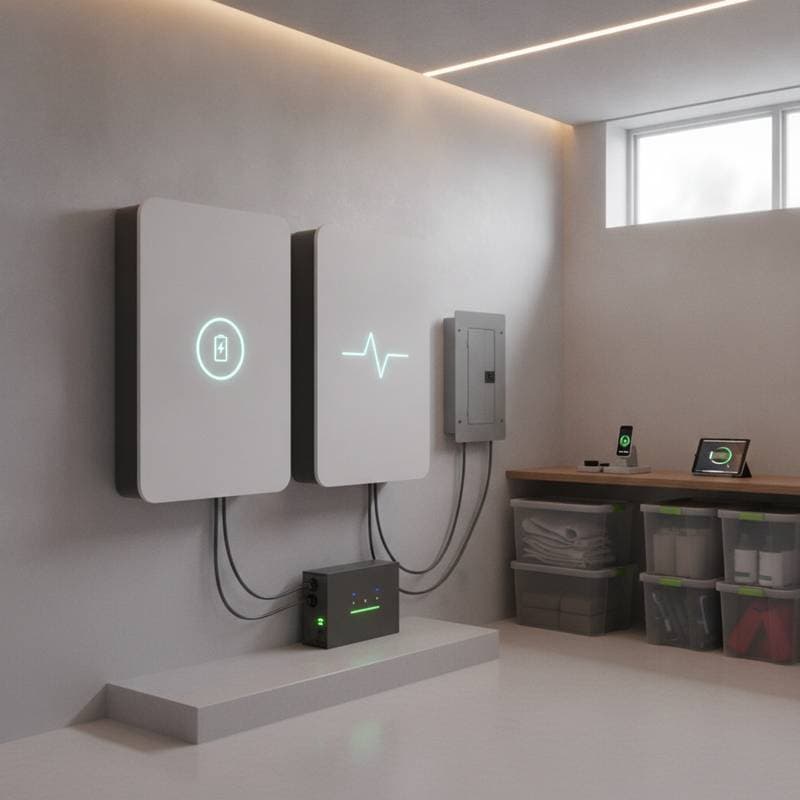
Install batteries in a ventilated space that maintains temperatures between 50 and 85 degrees Fahrenheit. Wall mounted units need at least 3 feet of clearance for service access. Floor mounted units should rest on a raised platform to prevent moisture contact.
Avoid attics and crawl spaces where temperature and humidity vary widely. Garages or utility rooms near the main electrical panel provide suitable locations.
Professional Installation
Homeowners considering self installation require torque wrenches, insulated tools, voltage testers, heavy duty brackets, grounding materials, and applicable permits. Professional installation by a licensed technician ensures compliance with the National Electrical Code and local standards.
Common Mistakes to Avoid
- Selecting insufficient capacity that fails during prolonged outages.
- Overlooking inverter sizing that cannot manage peak loads.
- Omitting required permits that may affect insurance coverage.
- Allowing poor ventilation that shortens battery life.
- Combining batteries of different ages or chemistries that reduce overall efficiency.
Addressing these factors at the outset supports reliable performance over many years.
Accessibility and Backup Priorities
Households that rely on medical equipment benefit from redundant battery configurations or generator integration. Label protected circuits at the electrical panel for quick identification during outages. Position wall mounted controls between 15 and 48 inches from the floor to meet accessibility guidelines.
Cost Considerations and Long Term Value
Upfront and Lifetime Costs
Although installation ranges from 8000 to 18000 dollars, reduced electricity expenses and increased energy security often offset the investment. Lithium ion systems typically cost 800 to 1000 dollars per kilowatt hour installed and require minimal upkeep.
Potential Savings
Pairing a battery with solar panels can lower grid dependence by 40 to 80 percent. Time of use utility programs allow charging during low rate periods and discharging when rates increase.
Warranty and Maintenance
Choose warranties that cover performance and capacity retention for at least ten years. Review battery management software and inspect connections annually.
Planning Your System
Begin by listing critical loads and calculating daily energy requirements. Consult a qualified installer to match equipment to those needs and confirm local code compliance. Proper sizing and installation deliver dependable backup power and lasting energy independence.