Understanding the 2026 Costs of Solar-Free Home Battery Backups
Homeowners seek greater control over their energy supply amid rising grid instability. A solar-free battery backup system provides essential power during outages without relying on photovoltaic integration. These systems vary in expense based on capacity, technology, local labor rates, and desired runtime, often ranging from moderate investments for basic needs to substantial outlays for comprehensive coverage.
This guide details the components of solar-free backups, from initial purchases to operational upkeep. It examines battery selections, setup processes, capacity determination, and enduring costs. Comparisons with solar-paired alternatives highlight trade-offs in efficiency, expense, and scalability to align choices with individual resilience objectives.
Breaking Down the Total Investment
Upfront pricing represents only part of the equation for battery backups. Comprehensive expenses encompass hardware acquisition, professional setup, electrical modifications, digital controls, and periodic servicing. Factoring these elements reveals the true path to dependable off-grid capability.
Core Hardware Expenses
Batteries dominate the budget as the primary storage component. Lithium-ion variants deliver compact, high-density power suitable for space-limited installations, whereas lithium iron phosphate (LFP) options emphasize durability, thermal resilience, and extended lifespans exceeding 10 years under moderate use.
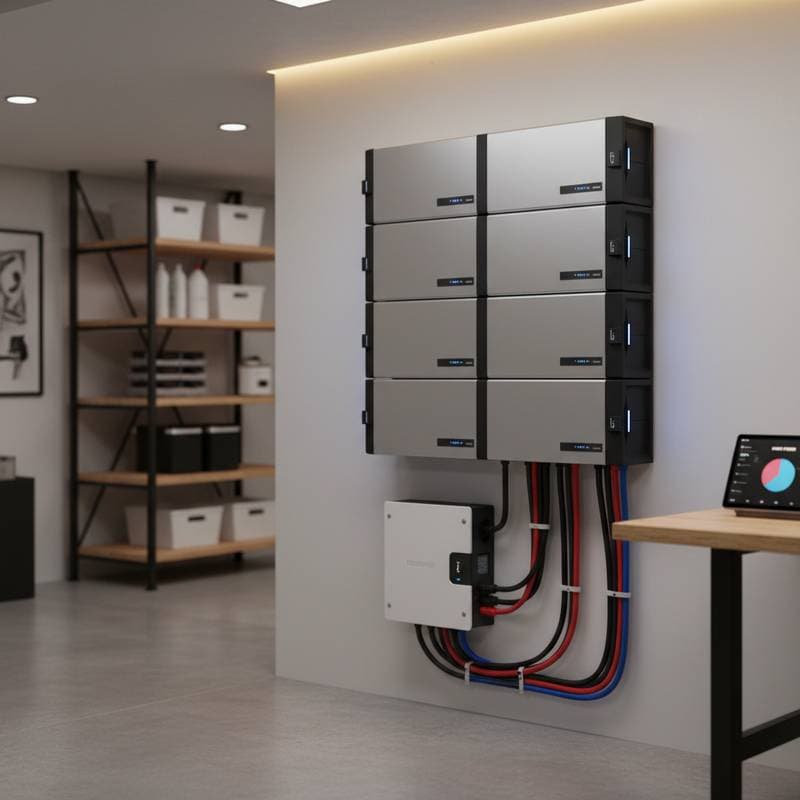
For essential loads like a refrigerator, basic lighting, and select outlets, a 10-13 kWh unit typically costs $8,000 to $15,000. Systems supporting full household demands, such as 20-30 kWh capacities, escalate to $20,000 or higher, excluding ancillary components like inverters.
Setup and Integration Fees
Installation contributes 20 to 30 percent of overall expenditure, involving panel upgrades, conduit routing, and compliance testing. Electricians handle load balancing and automatic transfer switches to enable seamless grid-to-battery transitions.
Homeowners frequently overlook the expertise required, as evidenced by discussions in energy communities. Substandard wiring risks system malfunctions or code violations, potentially incurring remediation fees that double initial outlays. Opt for certified professionals to safeguard performance and warranty validity.
Ongoing and Replacement Costs
Capacity degradation occurs gradually through repeated cycles and environmental stress, with most units warranted for 6,000 to 10,000 discharges. At 70 percent remaining capacity, replacement becomes advisable to maintain reliability.
Anticipate refresh expenses of 50 to 70 percent of original pricing, influenced by lithium market fluctuations and rebate programs. Budget annually for minor upkeep, such as filter changes, to extend service intervals and minimize unexpected disruptions.
Sizing Your System for Optimal Performance
Accurate dimensioning matches investment to needs, preventing excess spending or inadequate support. Begin with usage analysis to determine storage and output requirements, ensuring the setup handles daily essentials without compromise.
Step 1: Catalog Essential Appliances
Prioritize devices vital for safety and comfort. Typical selections include:
- Refrigerators or freezers (300-800 watts running, 1,200-2,000 watt startup)
- Network routers and charging stations (50-200 watts)
- LED fixtures in living spaces (100-500 watts total)
- Life-sustaining devices like CPAP machines (300-600 watts)
- Single-zone HVAC units (1,000-2,000 watts)
Sum running wattages and multiply by desired hours of operation. A 5 kWh daily need for these items guides minimum storage selection.
Step 2: Account for Startup Demands
Inductive loads, such as motors in fridges or pumps, generate inrush currents up to twice steady-state levels. Select inverters rated 1.5 to 2 times peak loads, often 3,000-5,000 watts for mid-sized homes, to avoid shutdowns during activation.
Step 3: Incorporate Expansion Potential
Modular designs from manufacturers like Tesla, LG, and Enphase allow capacity additions via parallel stacking. Initial purchases should include compatible interfaces, facilitating upgrades as energy habits evolve without full overhauls.
Ensuring Durability Through Maintenance
With diligent care, solar-free batteries sustain output for 10 to 15 years. Beyond routine charging, protocols address diagnostics, updates, and thermal regulation to optimize efficiency and avert premature wear.
Essential Monitoring Practices
- Examine terminals quarterly for oxidation or tightness.
- Review app notifications for anomalies in charge rates or voltage.
- Maintain unobstructed airflow around units to dissipate heat.
- Arrange biennial expert evaluations of cabling and power electronics.
Mitigating Site-Specific Risks
Fluctuations in ambient conditions accelerate decline; LFP tolerates -4 to 122 degrees Fahrenheit better than standard lithium-ion. Position indoors in tempered spaces like basements, or use enclosed cabinets for exterior placements to preserve chemistry integrity.
Weighing Professional Installation Against Self-Setup
Portable units suit DIY approaches for limited applications, connecting via standard outlets. However, integrated home systems demand specialized knowledge for subpanel integration and synchronization.
Experts verify neutral-ground bonds and simulate outage scenarios, confirming 100 percent load transfer within seconds. Such precision prevents hazards like arc faults or inverter overloads, while DIY errors may void coverage or trigger insurer scrutiny.
Solar-Free Versus Solar-Integrated Systems
Battery-only configurations excel in simplicity and lower entry costs, ideal for grid-tied homes with infrequent disruptions. They recharge via utility power, bypassing sunlight dependency for consistent availability.
Solar hybrids, by contrast, leverage panels for self-sustaining cycles, reducing lifetime bills through net metering. Yet they add $10,000 to $25,000 in panel expenses and require roof assessments. Choose solar-free for rapid deployment and focused backup, reserving expansions for future green shifts.
Securing Reliable Power for Your Home
Tailor solar-free backups to outage frequency and household scale for maximum return. Basic setups under $20,000 protect priorities affordably, while advanced arrays ensure uninterrupted operations at higher thresholds.
Assess vulnerabilities through energy audits, then procure vetted components. This approach yields not just survival during blackouts but enhanced autonomy, cost predictability, and adaptability to evolving grid challenges. Invest thoughtfully to fortify your residence against uncertainty.