Summer DIY AC Coil Cleaning versus Professional Cost Breakdown
Maintaining air conditioner efficiency during peak heat relies on clean coils. Accumulated dirt and dust obstruct airflow, compelling the unit to operate more strenuously. This increases energy consumption and accelerates wear on components. Homeowners frequently weigh the option of self-cleaning coils against engaging a professional, with decisions hinging on financial outlay, required equipment, safety considerations, and familiarity with routine upkeep.
Why Coil Cleaning Matters
Evaporator and condenser coils facilitate heat absorption and dissipation in the cooling process. Grime accumulation impairs their performance, diminishing overall efficiency. The compressor compensates by extending runtime to achieve desired temperatures, thereby elevating electricity usage. Routine cleaning restores optimal cooling capacity, enhances indoor air quality, and averts expensive future repairs.
Clean coils permit unobstructed air passage over the fins, alleviating stress on the fan motor and compressor. They also stabilize humidity levels, essential for comfort in humid environments.
Suggested image: A clear photo of an air conditioner coil before and after cleaning.
Alt text: Dirty AC coil on the left, clean shiny coil on the right.
DIY Coil Cleaning Basics
Self-cleaning coils offers cost savings when executed properly. The procedure demands careful attention, adequate time, and appropriate supplies. Overlooking safety protocols or selecting incompatible cleaners may harm system parts.
Tools and supplies:
- Soft brush or fin comb
- Non-acidic coil cleaner for indoor units
- Spray bottle or garden sprayer
- Protective gloves and eyewear
- Screwdriver for accessing panels
- Garden hose for outdoor units
Steps:
- Disconnect power at the breaker to prevent electrical hazards.
- Detach the outer cover or access panel.
- Gently brush off loose dust, pet hair, and debris.
- Apply coil cleaner uniformly, adhering to product instructions.
- Allow the solution to penetrate for 5 to 10 minutes to dissolve residue.
- Rinse thoroughly using low-pressure water, except with no-rinse formulations.
- Secure all panels and reconnect power.
Safety tip: Exercise caution to avoid damaging coil fins, which are fragile and critical for airflow. Employ a fin comb to repair any inadvertent bends.
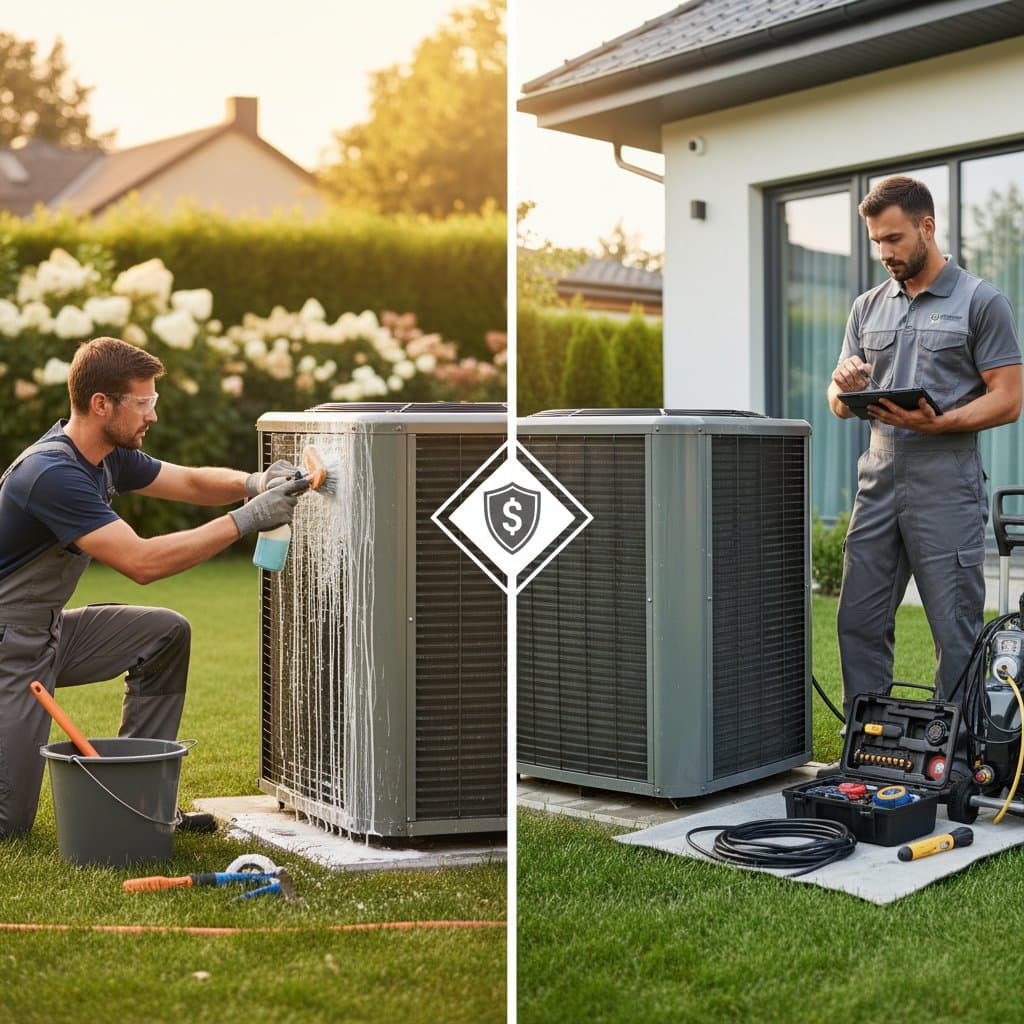
Suggested chart: A side-by-side comparison illustrating DIY costs against professional fees, categorized by supply items and service tiers.
DIY Cost Breakdown
Primary expenditures involve the cleaning agent and essential tools. A standard bottle of coil cleaner typically costs $10 to $20. A fin comb or soft brush incurs an additional $5 to $15. Households often possess screwdrivers and hoses already.
Estimated DIY cost range:
- Coil cleaner: $10 to $20
- Brush or fin comb: $5 to $15
- Safety gear: $5 to $10
- Time investment: 45 to 90 minutes
The aggregate expense remains substantially under $50, rendering DIY viable for budget-conscious individuals comfortable with minor mechanical tasks.
Benefits of Doing It Yourself
Opting for DIY saves on professional fees. It fosters familiarity with HVAC operations. Cleaning occurs on your schedule, addressing needs promptly. Proactive maintenance curbs escalation of small problems into significant failures.
Post-cleaning, cooling efficiency often improves noticeably within an hour. Participants in online home maintenance communities report enhanced airflow and lower temperatures immediately after the task, underscoring the merits of personal involvement.
When to Call a Professional
Expert intervention becomes necessary for severe blockages involving grease, mold, or corrosion. Professionals possess specialized equipment for safe remediation. Intricate setups, such as ducted systems or heat pumps, may necessitate disassembly beyond basic access.
Technicians deploy high-pressure rinsers, foaming agents, and endoscopic cameras for comprehensive reach.
Engage a professional if:
- The unit experiences recurrent freezing
- Unusual odors or noises emerge
- Refrigerant leakage indicators appear
- Uncertainty exists regarding panel removal
Professional Cleaning Costs
Standard services encompass inspection, chemical application, and fin alignment. Fees fluctuate by location and scope, generally aligning with $150 to $300 for a basic coil clean, comparable to seasonal tune-ups. Bundled packages frequently incorporate filter changes and refrigerant evaluations.
What professional service provides:
- Thorough decontamination using industrial solutions
- Evaluations of electrical and refrigerant integrity
- Enduring outcomes from advanced techniques
- Detailed maintenance documentation
Suggested image: Technician spraying foam cleaner on condenser coil outdoors.
Alt text: HVAC technician cleaning outdoor air conditioner coil with foam sprayer.
Comparing DIY and Pro Cleaning
| Feature | DIY Cleaning | Professional Cleaning |
|---|---|---|
| Cost | $20 to $50 | $150 to $300 |
| Time | 45 to 90 minutes | 30 to 60 minutes |
| Tools Required | Basic household items | Specialized equipment |
| Skill Level | Beginner to intermediate | Expert |
| Depth of Cleaning | Surface level | Comprehensive |
| Safety Risk | Moderate | Minimal |
| Frequency | As required | Annually or biannually |
Integrating DIY efforts biannually with periodic professional oversight optimizes expense and efficacy for many households.
Social Proof and Expert Insight
Maintenance forums feature HVAC specialists advocating pre-season outdoor coil cleaning. Surveys indicate that consistent upkeep lowers cooling expenses by up to 15 percent. This investment yields rapid returns via diminished utility costs and reduced repair frequency.
Experts emphasize that compressor malfunctions frequently originate from airflow restrictions. Routine coil maintenance shields the system from premature degradation.
Signs Your Coils Need Cleaning
- Discrepancy between thermostat setting and actual air temperature
- Apparent dust or debris on fin surfaces
- Unexplained spikes in energy consumption
- Ice accumulation around indoor coil enclosure
- Unusual odors upon unit activation
Addressing these prompts elevates cleaning to a priority task.
Establish Your AC Maintenance Schedule
Consistency defines effective coil care, whether through DIY or professional means. Pristine coils minimize operational stress and maximize indoor comfort. Set seasonal alerts to evaluate, brush, or flush coils prior to intense usage periods. Pair this with regular filter servicing to limit fin contamination.