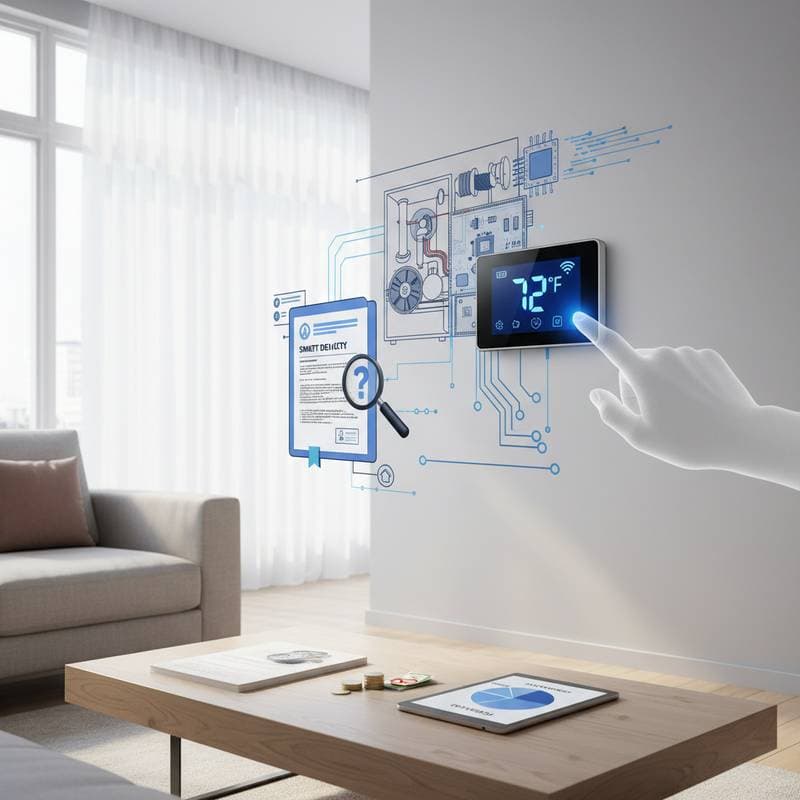
Home Warranties and Smart Thermostat Coverage
Homeowners increasingly install smart thermostats to enhance comfort and reduce energy use. These devices raise questions about coverage under home warranty plans. Policies often protect mechanical HVAC components but may exclude software-dependent features, creating uncertainty during failures.
Reviewing policy details early helps avoid unexpected expenses. Clear understanding supports informed decisions on repairs or replacements.
Core Elements of Home Warranty Protection
Home warranties safeguard mechanical systems and appliances against normal wear. They differ from homeowners insurance, which addresses perils like fire or theft. Standard coverage includes HVAC units, water heaters, plumbing, and electrical systems.
Thermostats typically qualify under HVAC provisions. Basic models that control temperature via simple wiring receive consistent protection. Smart versions, equipped with Wi-Fi, sensors, and app controls, encounter variable treatment across providers.
Some companies include smart thermostats as integral HVAC parts. Others categorize them as separate electronics, limiting or denying coverage for non-mechanical issues.
Challenges in Covering Smart Thermostats
Devices from brands like Google Nest, Ecobee, and Honeywell blend hardware with software for advanced functionality. Failures often stem from interconnected elements, complicating claim assessments.
Mechanical faults, such as a defective relay, may trigger coverage. Software glitches, connectivity disruptions, or firmware errors typically fall outside scope, as providers focus on physical HVAC components.
Homeowner forums, including Reddit threads, document frequent claim denials. One account described partial reimbursement due to software reliance, underscoring the need for precise policy review.
Key Policy Review Steps
Examine the HVAC section in your warranty document for thermostat references. Seek explicit inclusion of smart models or control systems. Ambiguous language on standard thermostats warrants direct inquiry.
Providers increasingly offer add-ons for connected devices, priced at ten to twenty dollars monthly. These extensions can offset costs exceeding hundreds for replacements.
Pose these targeted questions during plan selection:
- Does coverage extend to mechanical and electronic thermostat parts?
- Are software or connectivity failures addressed?
- What caps exist on smart device replacement values?
- Which brands or models face exclusions?
Expect detailed explanations on claim processes and included diagnostics.
Out-of-Pocket Expenses for Repairs
Without warranty support, thermostat fixes range widely. Simple replacements cost about one hundred dollars. High-end smart units exceed three hundred dollars.
Basic troubleshooting, like resets or network reconnections, allows self-resolution. Sensor or circuit board damage requires professional intervention.
Manufacturer warranties, often spanning one to five years, provide alternative protection. These cover defects but exclude installation or compatibility issues.
Strategies for Seamless Integration
Contact your warranty provider prior to installing a smart thermostat. Verify that the upgrade preserves overall HVAC coverage. Retain all documentation, including receipts and specifications.
Record troubleshooting efforts meticulously. If a thermostat malfunction impacts the broader HVAC system, claims may extend to those repairs.
Safeguarding Your Smart Home Setup
Smart thermostats deliver efficiency and control, yet demand vigilance on protection gaps. Home warranties remain vital for HVAC reliability when limits are acknowledged.
Ahead of seasonal demands, audit policy terms and device compatibility. Allocate a modest fund for potential electronic fixes. These measures ensure uninterrupted comfort and streamlined resolutions.