
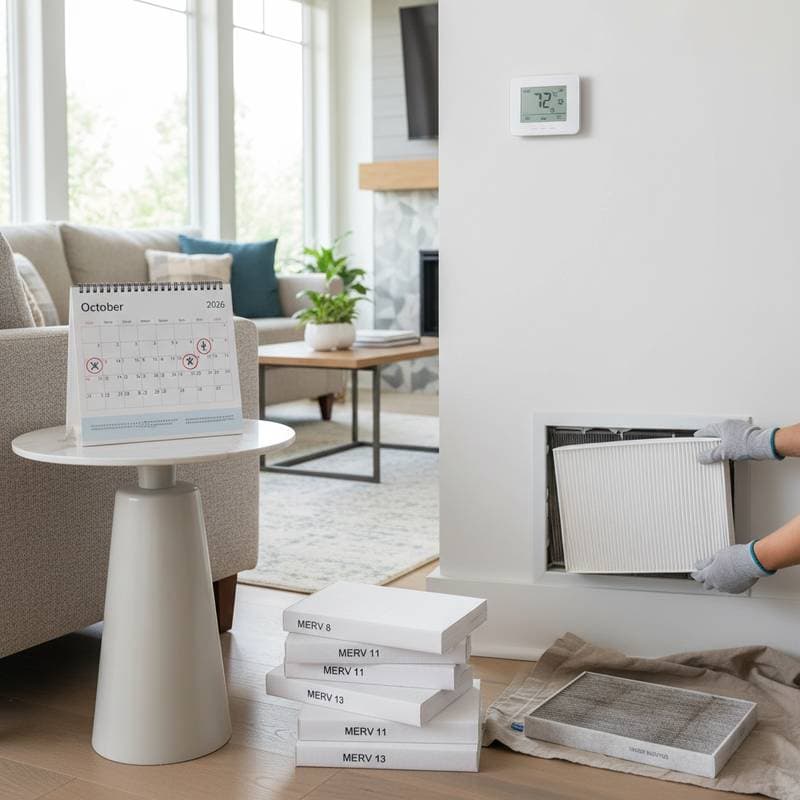
Establishing a Fall HVAC Filter Schedule to Enhance Home Air Quality
A home achieves optimal comfort when the air remains fresh and free from dust. With the onset of cooler temperatures, the heating system operates more frequently, placing greater demands on the HVAC filter. Implementing a dedicated fall HVAC filter schedule maintains cleaner indoor air and enables the furnace or heat pump to function with greater efficiency. Such a schedule reduces energy consumption, minimizes allergens, and prolongs the equipment's service life.
This guide provides a detailed overview of fall HVAC filter maintenance planning, covering replacement frequency, filter selection criteria, and strategies to ensure seamless system performance throughout the season.
The Importance of HVAC Filter Maintenance During Fall
As temperatures decline, windows remain closed for extended periods, making indoor air circulation reliant almost entirely on the HVAC system. Consequently, dust, pet dander, or residual pollen that evades the filter recirculates continuously within the home.
The primary function of an HVAC filter involves trapping airborne particles to prevent them from entering the blower motor or ductwork. A clogged or aged filter impedes airflow, compelling the system to exert additional effort. This increased strain elevates energy usage by as much as 15 percent. Moreover, dirty filters permit pollutants to persist, potentially exacerbating allergies and respiratory conditions.
Initiating fall with a structured maintenance plan safeguards both the HVAC system and household health.
Recommended Replacement Intervals: Every 30 to 90 Days
Homeowners typically replace or clean HVAC filters every 30 to 90 days, adjusted according to filter type and environmental factors within the home. For the fall season, install a new filter at the outset and inspect it on a monthly basis.
The following table summarizes key details:
| Filter Type | Common Thickness | Typical Lifespan | Best Practice for Fall |
|---|---|---|---|
| Fiberglass | 1 inch | 30 days | Replace monthly |
| Pleated (MERV 8-11) | 1 to 2 inches | 60 to 90 days | Inspect monthly, replace by 90 days |
| High-efficiency (MERV 12-16) | 1 to 5 inches | 90 to 120 days | Replace at fall's start |
| Washable electrostatic | 1 inch | Reusable | Wash every 30 days |
| HEPA (whole-house systems) | 4 to 6 inches | 6 to 12 months | Replace prior to intensive heating |
These intervals apply to standard household conditions. In homes with pets, allergy sufferers, or high dust levels, reduce the replacement interval by 15 to 30 days.
Steps to Develop an Effective Fall HVAC Filter Schedule
An effective schedule aligns with daily routines and specific system requirements. The subsequent steps outline a straightforward approach to maintaining clean air without unnecessary complexity.
Step 1: Determine Filter Size and Type
Accurate scheduling begins with identifying the precise filter specifications for the system. Residential HVAC units commonly accommodate filters ranging from 1 to 4 inches in thickness. Filter dimensions appear on the frame, formatted as measurements like 16x25x1 or 20x20x4 inches.
Verify dimensions by measuring height, width, and depth. An ill-fitting filter allows air to bypass edges, compromising overall efficiency.
For systems employing return air grille filters, measure the grille opening rather than the furnace compartment.
Step 2: Establish Seasonal Replacement Milestones
A memorable pattern leverages the transition between seasons as prompts. Install or clean filters at the commencement of fall, followed by a midpoint winter check. Record these dates in a calendar or configure recurring smartphone notifications.
In environments with pets or elevated dust, incorporate interim inspections between seasonal points. Remove the filter and position it against a light source. Absence of visible light transmission indicates the need for replacement.
Step 3: Select Filter Efficiency Based on Household Requirements
Filter performance is quantified by the Minimum Efficiency Reporting Value, known as MERV. Higher ratings correspond to superior capture of smaller particles.
- MERV 1-4: Provides fundamental dust filtration, ideal for window air conditioners or legacy systems.
- MERV 5-8: Offers standard protection against dust, pollen, and lint in typical homes.
- MERV 9-11: Enhances filtration for households with pets or moderate allergies.
- MERV 12-16: Effectively traps smoke, bacteria, and ultrafine pollutants.
- MERV 17-20: Represents HEPA-level filtration for advanced applications.
MERV 8 to 11 filters suit most residences effectively. Selecting higher ratings improves air purity but risks airflow restriction unless the blower motor accommodates the increased resistance. Consult the HVAC manual prior to any upgrade.
Step 4: Implement a Reliable Reminder Mechanism
Maintaining consistency surpasses occasional perfection. Choose reminders that integrate seamlessly into existing habits, such as notes affixed near the thermostat, automated mobile alerts, or a dedicated whiteboard in the utility area.
For systems requiring multiple filters, annotate each by installation location, for example, "hallway return" or "basement intake." This practice simplifies tracking replacement histories.
Step 5: Integrate Filter Maintenance with Seasonal Routines
Associating filter changes with other autumn tasks streamlines upkeep. Include HVAC filter replacement alongside activities such as:
- Adjusting ceiling fans to clockwise operation for better heat distribution
- Testing and replacing smoke detector batteries
- Flushing the water heater to remove sediment buildup
- Examining window seals for drafts
This integrated approach fosters habitual compliance, ensuring sustained system performance annually.
Selecting Optimal Filters for Fall Air Quality Challenges
Autumn introduces distinct indoor air contaminants, including dust from stored items, lingering pollen, and increased pet shedding. Appropriate filter selection addresses these issues directly.
Recommended Filters by Household Profile
| Home Type | Recommended MERV | Filter Thickness | Replacement Frequency |
|---|---|---|---|
| Small apartment | 8 | 1 inch | Every 60 days |
| Family home with pets | 10 | 1 to 2 inches | Every 45 to 60 days |
| Allergy-sensitive household | 12 | 2 to 4 inches | Every 60 days |
| High-efficiency system | 14+ | 4 to 5 inches | Every 90 days |
When uncertain, opt for a MERV 8 pleated filter, which provides an equitable balance of affordability, airflow preservation, and particle capture.
Pricing Overview and Sustained Benefits
Fiberglass filters range from 2 to 5 dollars per unit. Pleated mid-range options cost 10 to 25 dollars, while high-efficiency or HEPA variants span 40 to 80 dollars.
Although premium filters entail higher initial expenses, they decrease cleaning demands and prolong equipment durability. An unobstructed HVAC system optimizes energy use, potentially yielding 10 to 15 percent savings on fall heating expenses.
Pitfalls to Avoid in HVAC Filter Management
Even diligent homeowners encounter errors in filter maintenance. Steering clear of these issues preserves air quality and system integrity.
- Disregarding airflow orientation: Filters feature directional arrows; incorrect installation diminishes effectiveness.
- Prolonging use of aged filters: Accumulated debris may cause filter collapse into the blower area.
- Securing filter covers excessively tight: This action warps frames, permitting air leakage.
- Employing overly restrictive filters: Elevated MERV ratings burden older blower motors.
- Neglecting edge sealing: For slightly oversized slots, apply foam gasket tape to eliminate bypass gaps.
Addressing these concerns during installation averts efficiency losses and averts expensive future repairs.
Accommodations for Accessibility and Health Needs
Households facing respiratory vulnerabilities or physical limitations may find filter access challenging. Systems with return grille filters, positioned at ceiling level, facilitate easier retrieval and replacement.
For pronounced allergies, pair a MERV 13 filter with an ultraviolet air purifier integrated into the ductwork. This combination eliminates particles and neutralizes microbes, markedly elevating indoor air standards.
When depending on experts, request filter inspections during routine seasonal servicing.
Deciding Between DIY Replacement and Professional Service
Exchanging standard 1-inch filters qualifies as a simple do-it-yourself procedure. Required items include the matching replacement filter, a flashlight, and minimal time. Power down the system, extract the existing filter, and insert the new one ensuring arrows direct toward the furnace.
Professional intervention proves beneficial in scenarios where:
- Filter compartments prove inaccessible or embedded within ductwork
- Whole-house HEPA systems demand specialized handling
- Persistent dust or irregular airflow persists post-replacement
HVAC professionals charge 75 to 150 dollars for comprehensive evaluations and replacements, encompassing airflow pressure assessments and duct inspections.
Sustaining Long-Term Filter Maintenance Success
Long-term adherence to a fall HVAC filter schedule demands intentional strategies beyond initial setup. Regularly review household changes, such as new pets or renovations, that might necessitate adjusted intervals. Track energy bills quarterly to gauge the impact of consistent maintenance on efficiency gains.
Engage family members in the process by assigning rotation for checks, transforming routine tasks into shared responsibilities. Over time, this discipline not only elevates air quality but also cultivates a proactive approach to home care, yielding enduring comfort and cost efficiencies.




